
Every day, consumers tell brands what they think.
They share product experiences on social media, leave reviews on e-commerce platforms, contact customer service, and file complaints when something goes wrong.
For one leading maternal and infant care brand, that meant more than one million new pieces of customer feedback every day, spread across e-commerce reviews, social media, and customer service records.
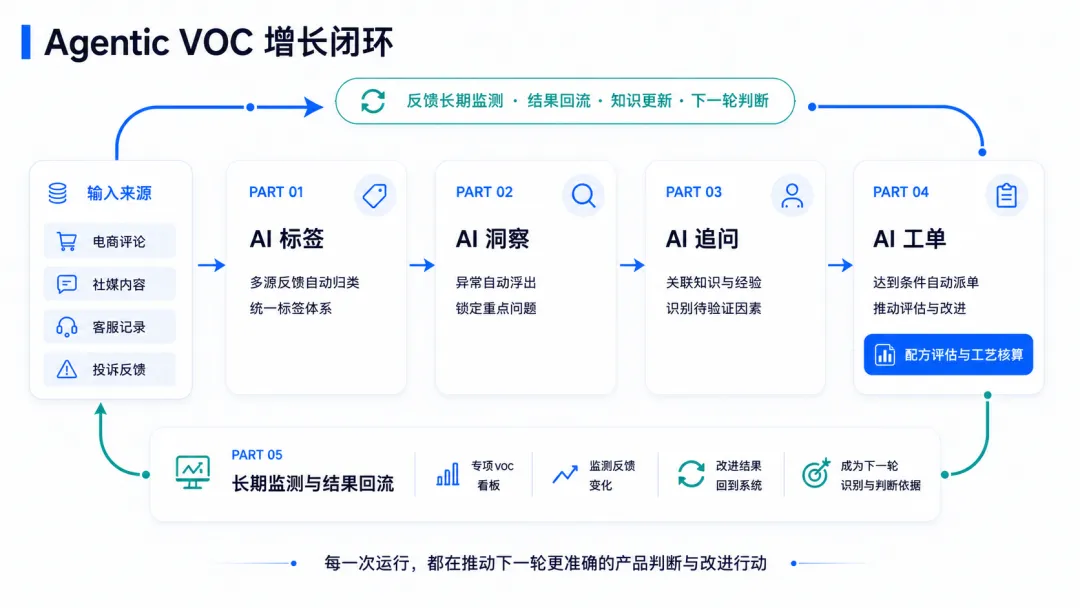
The company already had a social listening system that aggregated this data into more than a hundred dashboards, tracking metrics such as positive and negative sentiment.
But one critical question remained unanswered:
What should the business actually do about it?
Enterprises rarely suffer from a lack of dashboards. The harder problem is identifying which customer signals matter, understanding what is driving them, and turning those insights into action.
To address this, the brand adopted DeepZero DeepVOC, an agentic Voice of Customer system in which multiple AI agents work continuously across feedback classification, anomaly detection, root-cause investigation, decision support, and action execution.
The results of those actions are then fed back into the system, helping refine the next round of analysis and decisions.
A formula optimization opportunity discovered in one of the brand's infant formula product lines shows how this works in practice.
DeepTag: Turning Fragmented Feedback into Structured Customer Signals
“My baby hasn't had a bowel movement for several days.”
“This formula seems to cause too much internal heat.”
“My baby had trouble adjusting after switching to Stage 2.”
Consumers can describe the same underlying experience in very different ways. Those comments may also appear across completely different channels, from e-commerce reviews and social posts to customer service conversations.
Traditional keyword or predefined-tag systems struggle with this variation.
DeepTag, DeepVOC's AI tagging agent, interprets and classifies feedback across multiple data sources at scale.
It automatically applies hierarchical tags to customer feedback while also identifying concepts that were not included in the original taxonomy. When consumers repeatedly raise a new issue, DeepTag can dynamically create new tags rather than forcing the feedback into an outdated classification structure.
This enabled the brand to build a unified, granular four-level taxonomy across its customer feedback data.
As a result, overall tagging accuracy increased from approximately 70% to 95%.
AI Insight Agents: Detecting an Anomaly and Investigating What Was Driving It
Once customer feedback is consistently structured, the system can move beyond counting mentions and begin identifying meaningful changes.
DeepVOC's AI Insight Agent continuously monitors negative feedback across products, issue categories, and time periods, combining anomaly detection with multidimensional analysis.
During this process, the system identified a significant signal: feedback related to constipation for one infant formula line had nearly doubled over the previous month.
Rather than treating the increase as another sentiment metric on a dashboard, DeepVOC flagged it as an issue requiring further investigation.
An AI Investigation Agent then began asking the next question: why was this happening?
Through iterative analysis, correlation checks, and validation across multiple data sources, the system examined possible external factors such as formula transitions, feeding practices, and preparation methods.
As those explanations were progressively ruled out, the analysis narrowed toward differences in the formulation between product stages.
What had initially appeared as thousands of scattered and loosely worded consumer complaints was transformed into a specific product issue that the business could evaluate further.
AI Work Order Agent: Turning an Insight into Product Action
Finding the signal is only useful if the organization can act on it.
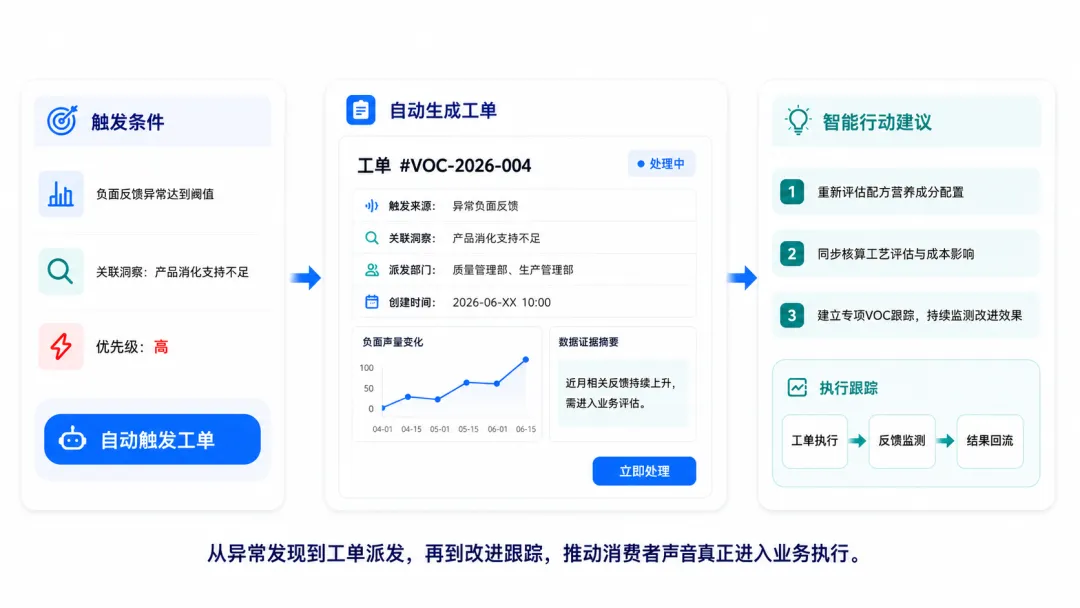
When negative feedback associated with the issue exceeded a predefined threshold, DeepVOC's AI Work Order Agent connected the anomaly with the preceding analysis, automatically created a high-priority work order, and routed it to the relevant teams.
The system also provided recommended next steps, including a reassessment of nutritional composition and an evaluation of the related production costs.
From there, the agent continued to track execution progress, while a dedicated long-term VOC dashboard monitored subsequent changes in consumer feedback.
The outcome of those actions was then fed back into DeepVOC, becoming new evidence for future detection, analysis, and decision-making.
In other words, customer feedback was no longer the endpoint of a reporting process. It became part of an operational feedback loop.
From Listening to Acting
DeepVOC is not designed simply to produce another customer insight report.
It enables multiple AI agents to work toward the same business objective, sharing context and outputs as they move continuously through signal detection, analysis, investigation, decision support, action, and feedback.
For enterprises processing customer feedback at massive scale, the value of VOC is not knowing that customers are talking.
It is knowing which signals deserve attention, what they mean for the business, and what action should follow.
That is the role of DeepVOC: turning the voice of the customer into an operating system for continuous business improvement.
And it reflects what AI for Growth means at DeepZero—using AI not simply to understand the business, but to help the business decide and act.