
A category can look like a major growth opportunity when a new product project begins—and be crowded with competitors by the time the product reaches the shelf.
This is one of the most persistent challenges in product innovation.
A new product may take up to two years to move from research and validation to market launch. In highly competitive markets such as China, however, an emerging opportunity can change within a matter of months.
The problem is rarely a lack of ideas. The real challenge is making the right decisions at every stage of the innovation process:
- Identify demand: Data is fragmented and research samples are limited, making it easy to miss genuine consumer needs.
- Prioritize opportunities: Multiple opportunities often emerge at the same time, while prioritization still depends heavily on manual judgment and experience.
- Develop concepts: Product concepts can quickly become undifferentiated or disconnected from real consumer needs.
- Validate feasibility: Cross-functional collaboration is often sequential and time-consuming, slowing down decision-making.
- Test market potential: Consumer feedback arrives late, leaving little time for rapid iteration.
A poor decision at any one of these stages can cost more than time and development resources. It can mean missing the market opportunity altogether.
DeepZero has launched AI New Product Innovation, an AI-powered decision system designed for enterprise product development and innovation.
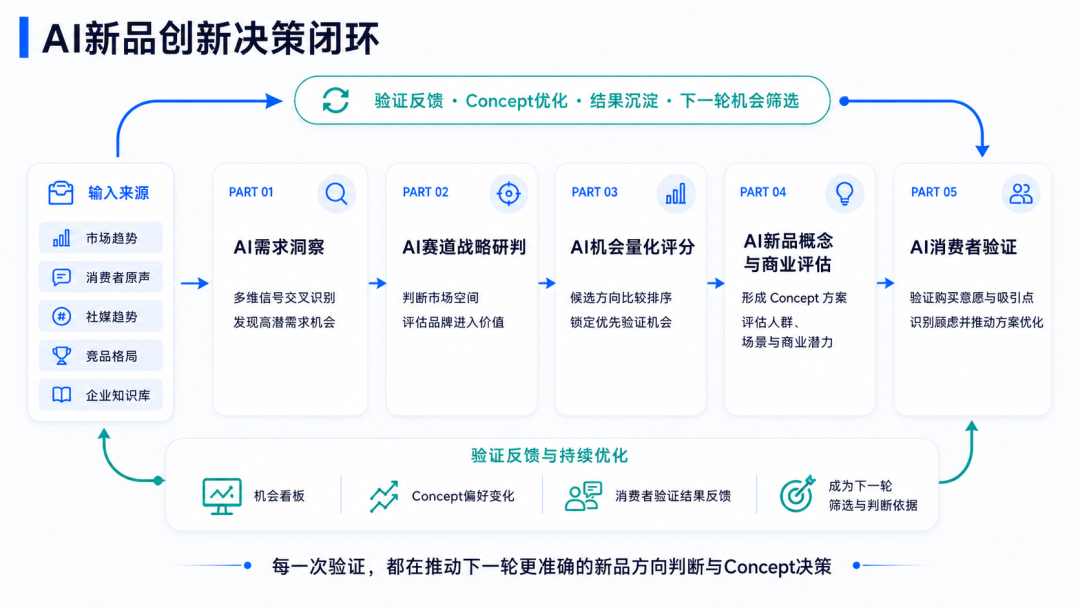
Multiple AI agents work toward the same product innovation objective, continuously advancing opportunity discovery, strategic evaluation, concept development, and concept validation. Together, they form a closed-loop decision process that helps enterprises identify opportunities earlier, validate them more accurately, and connect product innovation more directly to business growth.
01. AI Opportunity Discovery
Identifying High-Potential Opportunities from Complex Market Signals
A consumer need that appears frequently may indicate a genuine emerging opportunity—or simply a short-lived trend.
Likewise, a market space that appears underserved at first glance may already be highly competitive once the broader category landscape is taken into account.
The AI Consumer Demand Insights Agent begins by analyzing multiple sources together, including market performance, voice-of-consumer data, social trends, and the competitive landscape. These signals are then evaluated against proprietary industry know-how and enterprise knowledge bases to distinguish meaningful demand from market noise.
The next question is whether the opportunity is worth pursuing.
The AI Market Opportunity Strategy Agent evaluates market size, category dynamics, and competitive intensity. The AI Opportunity Scoring Agent then compares multiple candidate opportunities, scores them across key dimensions, and helps establish a clear order of priority.
The output is no longer simply a list of trends that may be worth watching.
Enterprises gain a clearer view of which opportunities are supported by evidence, which directions deserve further validation, and why.
02. AI Market Feasibility Validation
Turning High-Potential Opportunities into Actionable Product Decisions
Identifying an attractive opportunity is only the beginning.
Before committing significant product development resources, enterprises still need to answer three fundamental questions:
What kind of product should be developed around this opportunity?
Is the market large and attractive enough to support it?
And most importantly, will consumers actually want to buy it?
The AI New Product Concept and Commercial Evaluation Agent translates high-potential opportunities into concrete product concepts. It brings together the target audience, usage occasions, core consumer needs, and product value proposition to create structured product directions, while also evaluating market potential and commercial viability.
Once product concepts have been developed, AI New Product Innovation works together with AI Consumer Agents to test purchase intent, key drivers of appeal, and potential consumer concerns.
The results are then fed back into concept refinement and strategic direction.
This creates an iterative decision loop: concepts are generated, tested, compared, and refined until the organization has stronger evidence for where to invest.
An opportunity can therefore move from simply being “worth exploring” to being supported by evidence as “worth investing in.”
From Weeks of Research to Hours of Decision Support
This approach is already being applied in real product innovation projects.
A leading beverage brand previously required three to six weeks to complete a typical round of consumer research and product concept screening. In a market where consumer preferences and competitive dynamics can change rapidly, the traditional process increasingly struggled to keep pace with business decision-making.
After adopting AI New Product Innovation, multiple AI agents worked together to analyze combined signals from the market, consumers, and competitors.
The system identified a high-potential opportunity around “lighter consumption and everyday wellness management.” Market assessment and AI consumer testing then helped narrow the opportunity into two priority product concepts.
The product research cycle was reduced from several weeks to a matter of hours, while purchase intent for the selected priority concepts improved by approximately 20% compared with the initial concepts.
Making Product Innovation More Decision-Driven
As market windows become shorter, competitive advantage increasingly depends not on how much information an organization can collect, but on how quickly it can turn evidence into better decisions.
AI New Product Innovation brings multiple AI agents into the critical stages of product innovation—from opportunity discovery and strategic evaluation to concept development and consumer validation.
By reducing manual bottlenecks, connecting fragmented signals, and continuously validating decisions, the system helps enterprises identify stronger opportunities earlier and move promising ideas toward market with greater confidence.
The goal is not simply to generate more ideas.
It is to help enterprises make faster, more evidence-based product decisions—and improve the odds that the products they invest in are aligned with real market demand.