
Consumer research sits behind some of the most important decisions consumer brands make.
What should the next product be? Which creative should go live? Which proposition is most likely to resonate?
All of these questions ultimately come down to one thing:
Will the target consumer choose it?
Traditional consumer research, however, often takes weeks to move from participant recruitment and fieldwork to analysis. That pace is increasingly disconnected from the speed at which businesses need to make decisions.
And speed is only part of the challenge.
Even when a research project is completed, limited sample sizes, execution bias, and inconsistent research quality can still produce findings that appear convincing but fail to reflect how target consumers will actually respond.
DeepZero has launched Enterprise AI Consumers, an AI-powered consumer research system built for enterprise research and decision-validation scenarios.
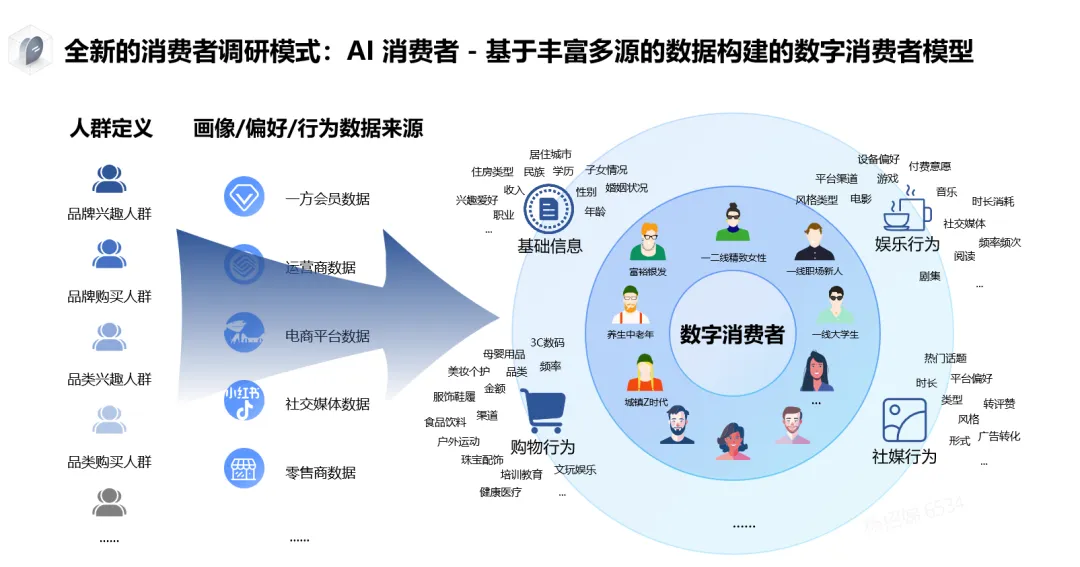
The system builds target AI Consumers using enterprise first-party data, multi-source consumer data, and industry knowledge, and supports research workflows including surveys, interviews, analysis, and insight generation.
These AI Consumers can then participate continuously in the validation of new products, product propositions, marketing creatives, and other key business decisions—helping consumer research evolve from periodic, project-based studies into a model of continuous research and validation.
AI Consumers are already being used in live business environments by several leading enterprise customers, supporting use cases across new product research, product design, marketing creative testing, and other decision-making scenarios.
01. AI Consumer Modeling
Building Consumer Responses on Real Data
It is relatively easy to ask a large language model to simulate a consumer based on a few inputs such as age, city, and interests.
The much harder questions are:
Why should this simulated consumer represent the target audience? What evidence supports its decisions? And can those decisions be validated?
The AI Consumer Modeling Agent starts with enterprise first-party data and combines it with multi-source consumer data and industry knowledge.
It builds more granular consumer models across dimensions including demographic attributes, shopping behavior, interests and preferences, media behavior, and brand relationships.
For every research project, enterprises can trace which consumer segments were selected, what characteristics define them, and what data and knowledge support their responses.
This makes the research process more transparent and verifiable.
Instead of receiving only a one-off research report, enterprises gain a reusable set of target AI Consumers that can participate repeatedly in future research and decision validation.
02. End-to-End AI Consumer Research
Bringing Consumer Feedback into Every Critical Decision
Once a new product concept has been developed, AI Consumers can evaluate purchase intent, identify key sources of appeal, and surface potential concerns.
When several product designs, packaging options, or visual directions are under consideration, they can compare, score, and rank the alternatives.
Before an advertising campaign goes live, brands can test which creative is more likely to appeal to the target audience—and understand why.
The system also goes beyond quantitative results.
Teams can conduct in-depth conversations with multiple AI Consumers to explore the motivations, needs, and concerns behind their choices.
When a concept or creative is revised, the same target AI Consumers can immediately participate in the next round of testing.
This creates a continuous loop:
Develop → Validate → Refine → Revalidate
Consumer feedback can therefore become part of ongoing decisions across brand strategy, product development, marketing, and user growth, rather than being limited to isolated research projects.
03. From Product Research to Live Market Validation
Testing AI Consumer Decisions Against Real-World Outcomes
AI Consumers are already being deployed in live business scenarios, where their recommendations can be compared directly with actual market performance.
For a premium skincare brand, three advertising creatives were evaluated by AI Consumers before launch.
Approximately 60% of the AI Consumers preferred Creative A.
After the campaign went live, Creative A also delivered a clearly higher click-through rate than the alternatives.
In this case, the preference identified by AI Consumers was subsequently supported by real-world campaign performance.
AI Consumers have also been used in new product research for a leading beverage brand.
By testing product concepts with AI Consumers, the brand narrowed the field to two priority concepts, with purchase intent improving by approximately 20% compared with the initial concepts.
The range of decisions being tested continues to expand.
Which packaging design is more appealing? How do preferences differ across regions? Why do visitors choose one theme park over another? Which product name is more likely to be accepted?
Across these scenarios, AI Consumers are becoming an increasingly reusable decision capability within the enterprise.
A New Model for Consumer Research
The most important change AI Consumers bring is not simply faster research.
It is a different operating model for how consumer insight enters business decision-making.
When consumer research becomes scalable, continuous, and verifiable, feedback can be introduced earlier, more frequently, and more systematically across the decision process.
Instead of waiting weeks for the next research project to be completed, enterprises can continuously test assumptions, compare alternatives, refine ideas, and validate decisions before committing greater resources.
That shifts consumer research from a periodic support function into an ongoing decision capability—helping businesses make faster, more evidence-based choices across product, brand, and marketing.